
The construction and function of the forming tool
The process of compression molding rubber begins with the manufacturing of a mold, typically made of metal, with cavities that represent the desired shape and size of the rubber product. The mold usually consists of two mold-forming halves, an upper and a lower half, which can be opened and closed relative to each other.
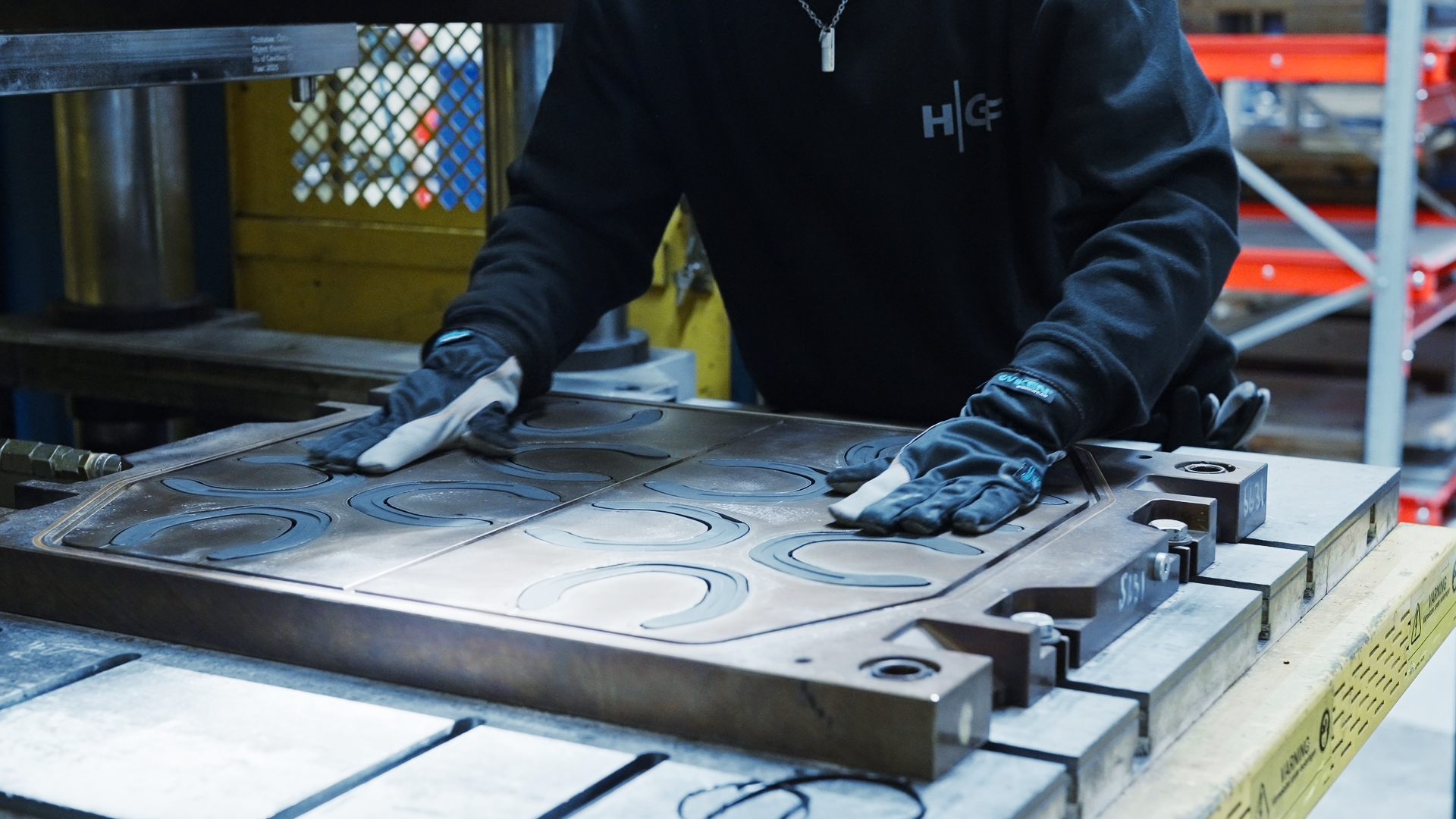
This is how compression molding works
To begin the compression molding process, a carefully weighed amount of mixed rubber is prepared in varying shapes (preforms) depending on the cavity design. The preforms, which are placed into the cavities, are made by a cutting process directly from rubber compound sheets or the rubber compound is extruded through a die that forms a profile which is cut to appropriate lengths.
These materials are then placed into the cavities and the mold is carefully closed to ensure that the rubber compound is evenly distributed within the cavities. This is important for achieving the desired properties and dimensions of the rubber product.
After the rubber is placed in the cavities and the mold is closed, the vulcanization process begins by applying heat and pressure. Heat transfer between the mold and the rubber is crucial for the vulcanization process to start. Because rubber has low thermal conductivity, it heats up slowly and the vulcanization time is therefore relatively long.
Typical vulcanization times range from minutes for thin-walled goods to hours for thick-walled products. In the latter case, preheating the rubber, for example in a heat oven or by extruding the rubber compound, is effective.
Vulcanization of rubber is a chemical process where raw rubber is transformed into a stronger and more elastic form by cross-linking polymer chains. This process imparts rubber with its final properties such as abrasion resistance, elasticity and chemical resistance.
After a predetermined vulcanization time, the mold is opened and the finished rubber product is removed from the mold. Any excess material is removed to give the product its final shape and surface finish. To ensure that the cavities in the mold are filled, a certain amount of "overfill" of material is required, often in the range of 5–10%.
The advantages of compression molding are primarily the following:
1. The method is simple with relatively inexpensive tools. Suitable for small batches.
2. Enables molding of several different components and materials.
3. Suitable for products with a large surface area or wide distribution.
4. Can be used for rubber compounds with high viscosity and poor flowability.
5. Compression molding is a good option when products with complex geometries and varying wall thicknesses are required.
In summary, rubber compression molding is a proven, reliable, and flexible manufacturing method that has been used for many years. Its ability to produce complex parts with high precision, combined with cost-effectiveness for small to medium production runs, makes it a frequently used option in the rubber industry.