
Advanced injection molding for maximum repeatability
Rubber injection molding is a more sophisticated and technologically advanced manufacturing method compared to rubber compression molding. Over the years, it has become increasingly widespread in the rubber processing industry, and the process enables the production of complex rubber products with both high precision and repeatability.
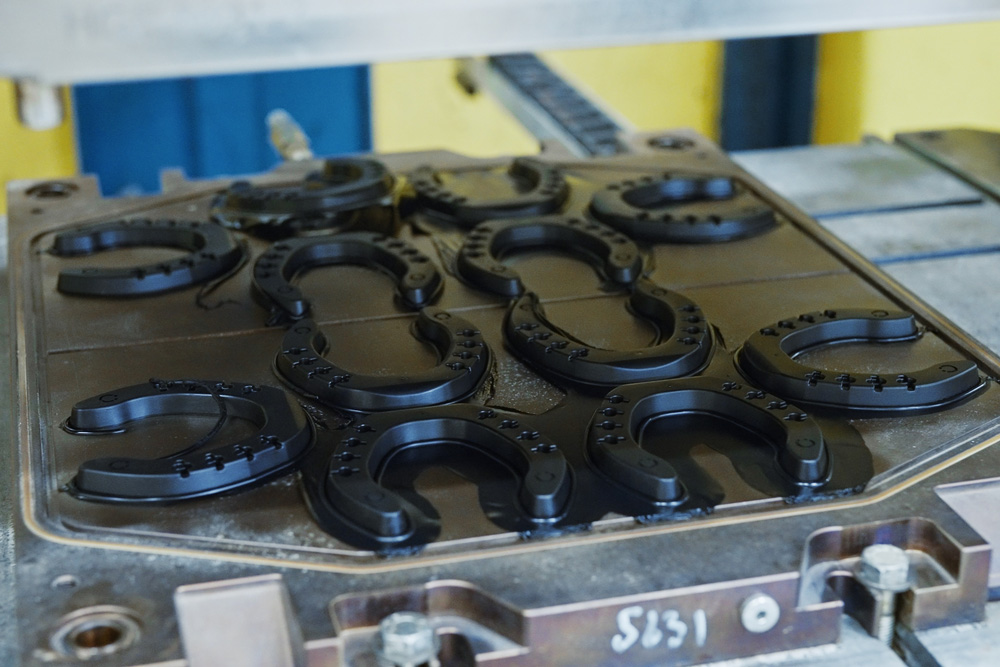
How injection molding works
To begin the injection molding process, unvulcanized rubber is fed into a heated chamber. Once the rubber material is in a liquid state, it is injected under high pressure into the mold through a syringe or nozzle. The pressure ensures that the molten rubber fills all cavities. This allows for significantly better control and regulation of temperatures and pressure.
Vulcanization via injection molding of rubber is often faster than other methods, such as compression molding. This is due to the high pressure and temperature levels that can be maintained. This, in turn, results in shorter cycle times and thus higher output. In addition, the controlled injection process results in lower material consumption and less waste compared to compression molding, while also providing greater flexibility for embedding various components within the rubber part.
After the vulcanization process is completed and the rubber material has hardened, the mold is opened and the finished rubber products can be removed for cooling and inspection. Any excess material or flash is removed before the product can be assessed as meeting the specified requirements.
The advantages of rubber injection molding include the possibility of high automation, which results in increased production efficiency, among other benefits. The method is particularly suitable for high-volume manufacturing and can offer cost-effective solutions for products with complex geometries and high requirements.
Below is a brief summary of some of the many benefits of injection molding rubber:
- Preheating the rubber shortens the vulcanization time
- Because the rubber is preheated, it flows more easily and fills the mold cavity more effectively
- The tool is closed when rubber is injected, which results in less flash and better dimensional tolerances for the product.
- In rubber-to-metal bonding, the rubber makes better contact with the metal when the surface is "fresh" and clean
- The process can be automated
In summary, rubber injection molding is an advanced and versatile manufacturing method that enables the production of high-quality rubber products with high precision and efficiency.