
A full-service supplier with in-house rubber compounding
Since HGF was founded in the 1940s, we have had our own department for rubber compounding. This is something we have focused on and which our customers see as a major advantage, as it allows for short lead times both during the development phase of new materials and for the compounding of rubber for ongoing production. At the same time, our compounding department gives us the ability for full traceability and allows us to control and manage all components included in our materials, while not being dependent on external suppliers to the same extent. These factors, combined with our technicians developing customized rubber materials based on customer specifications and wishes, make HGF a full-service supplier.
The mixing department – The heart of HGF's production
The mixing department is the very heart of HGF's operations, and it's here that the journey from recipe to molded rubber product begins. Rubber mixing is the first step, resulting in the semi-finished product that is then vulcanized and molded into finished rubber products. The basic principles of rubber mixing have not changed much since the practice of mixing rubber first began. Development and modernization have primarily occurred in terms of machine capacity, control, work environment, and environmental improvement measures.
The mixing department is composed of various parts presented below.
Weighing
The first operation in rubber mixing is weighing according to predetermined recipes. Rubber polymer is weighed directly from pallets onto a belt scale. Carbon black, oil and any light fillers are weighed automatically as the rubber mixing proceeds. Ingredients present in smaller quantities are weighed manually.
Chamber mixer
A chamber mixer consists of two rotors in a chamber. The rotors have a design that creates a kneading effect. At the bottom of the chamber, there is an openable hatch, and at the top, a "lid" that is height-adjustable between open and closed positions.
During the mixing cycle, ingredients are added through the upper hatch or via separate pipes. The speed of the rotors can be steplessly adjusted during the mixing process itself. The speed can, for example, be increased when plasticizers are added and the viscosity and degree of processing otherwise decrease.
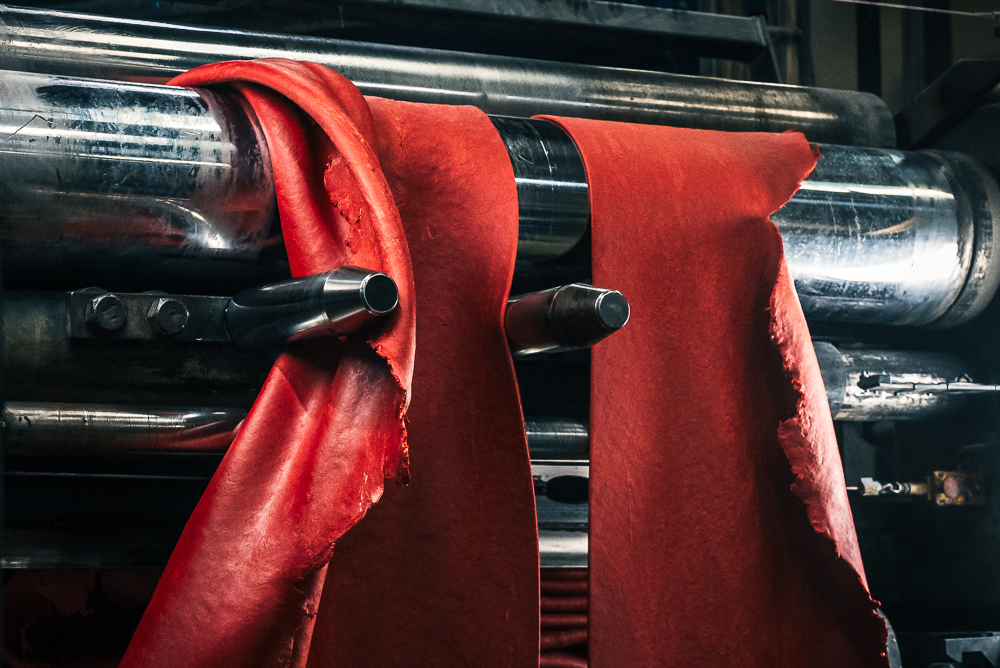
When the mixture is ready, the hot mass is discharged through the bottom hatch. The mass needs to be quickly flattened and cooled to reduce the risk of the mass beginning to vulcanize. This is done by first allowing the mass to pass through a roller mill and then be transported through a water bath.
After this, the semi-finished product is coated with an anti-tack agent and the rubber has largely cooled and can be placed in a cart for further transport to HGF's FIFO warehouse and then onward for processing in the form of molding.
HGF has the capability to blend materials both in the laboratory and in our blending department, which provides us with high flexibility during all project and production phases. The mixer used in the laboratory is used to initially create smaller material batches for lab tests before moving on to full-scale production. Everything from material development and prototype manufacturing to series production.